


Authors: Nerea Jimenez Zumalde, Jasone Astorga Burgo
Organization: University of the Basque Country (UPV/EHU)
The increasing need for resilient and rapidly deployable communication systems has become evident in scenarios where traditional network infrastructure is damaged, unavailable, or simply does not exist. Natural disasters, large-scale emergencies, and remote operations—such as those conducted in mountainous or forested areas—pose significant challenges for connectivity and mission-critical coordination. Within the NANCY project, the University of the Basque Country (UPV/EHU) addresses this challenge by designing and deploying a testbed that combines C-V2X, UAV-borne communications, and lightweight 5G systems to create flexible and secure networks for infrastructure-less environments.
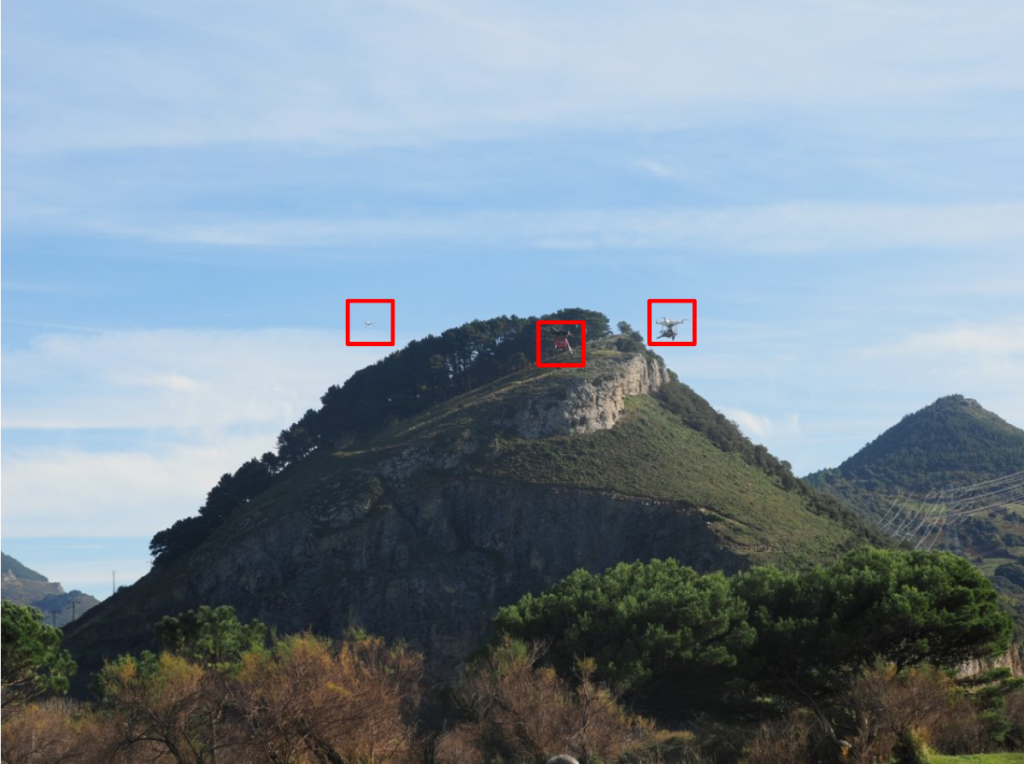
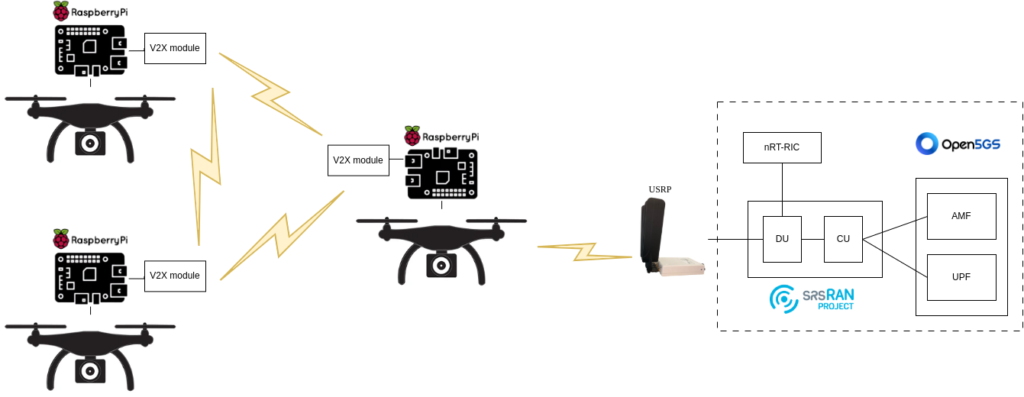
At the core of our contribution is an experimental architecture that leverages unmanned aerial vehicles (UAVs) as airborne communication nodes capable of forming an ad-hoc multi-hop network. Each UAV carries a Raspberry Pi equipped with a C-V2X module, enabling direct sidelink communication among nodes even in the complete absence of terrestrial infrastructure.
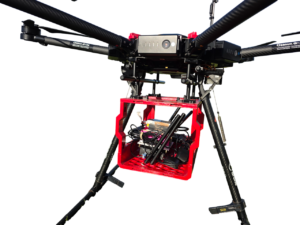
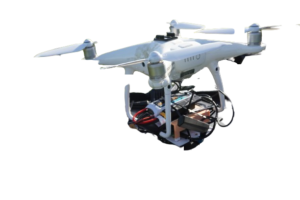
One UAV acts as a relay node and incorporates an additional 5G radio module, connecting the aerial C-V2X mesh to a dedicated 5G RAN implemented with srsRAN and a 5G Core based on Open5GS. This integration makes it possible to extend coverage and support connectivity. This mesh network operates using the B.A.T.M.A.N.-adv routing protocol, a decentralized layer-2 protocol that enables dynamic, self-healing route selection between nodes, ensuring efficient data forwarding across the mesh.
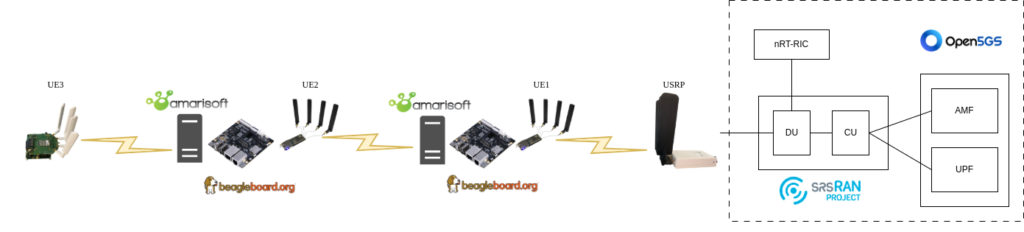
Complementing the UAV scenario, UPV/EHU has also developed a second use case based on multi-hop 5G connectivity using ground-based equipment. This configuration employs 5G hardware that, due to weight and power constraints, cannot be mounted on aerial platforms but can be deployed on vehicles such as trucks or cars. While not airborne, these nodes offer increased processing capability, higher throughput, and fewer physical limitations, making them suitable for extended coverage and high-bandwidth applications. Together, the aerial C-V2X testbed and the ground-based 5G multi-hop setup create a complementary experimentation environment to enable coverage extension in different scenarios.
Through the integration with NANCY components, both scenarios support automated workflows for secure and flexible service provisioning. The demonstrator integrates with Slice Manager, which orchestrates the service requests arriving at EHU’s operator, and handles the deployment in the MEC of the containerized application components that serve the users. Furthermore, Slice Manager also handles the intelligent resource allocation in O-RAN to fulfill the SLAs requested by each user. In addition to Slice Manager, the demonstrator integrates with NANCY’s Self-Sovereign Identity (SSI) to manage the authentication and authorization of the users and of the platform. Through the integration of SSI and NANCY’s blockchain into the service provisioning workflow of the testbed, users can authenticate and be authorized to the services provided by the operator using decentralized identities (DID) and verifiable credentials.
Overall, the UPV/EHU contribution demonstrates how rapidly deployable, secure, and intelligent communication infrastructures can be built by combining UAV-based C-V2X networks with next-generation 5G systems.